
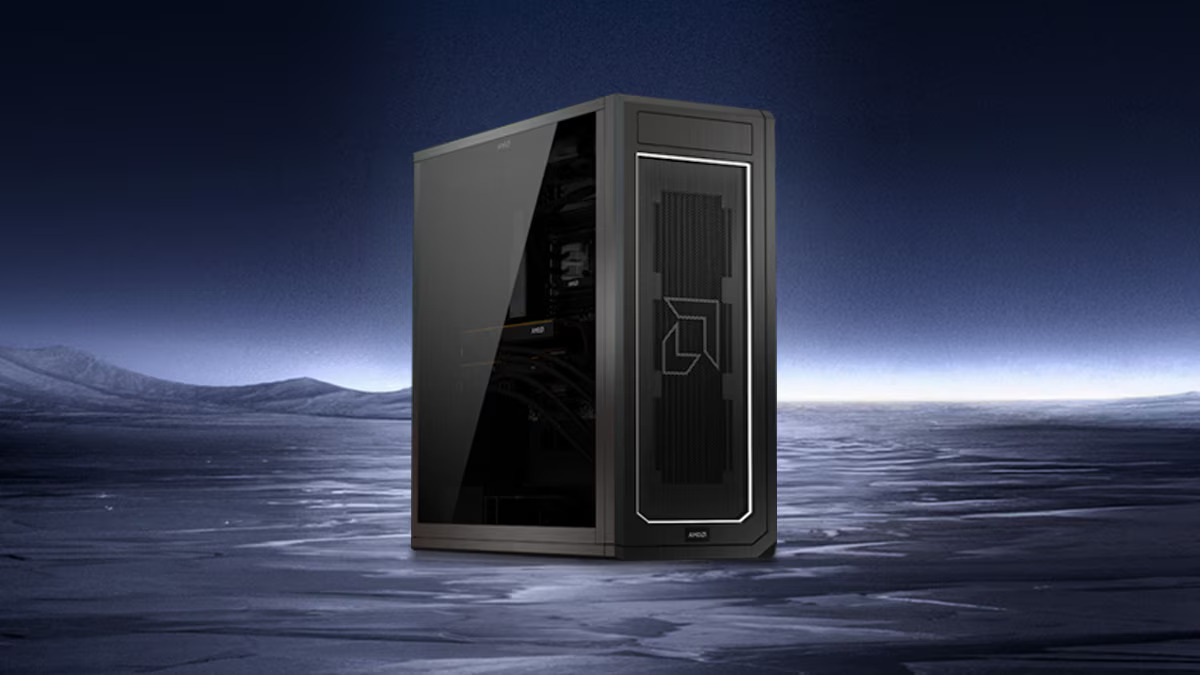
Running AI locally usually means choosing a smaller model that can fit into the memory available on your laptop or desktop. AMD’s new Threadripper Halo Station takes that idea to an entirely different level.
Unveiled at IFA 2026, the prototype workstation is designed to bring datacenter-class AI compute to a desk, combining a 96-core Ryzen Threadripper PRO 9995WX processor with AMD Instinct-class accelerators. AMD says configurations can be built with enough memory to run AI models exceeding one trillion parameters locally.
That’s less about replacing ChatGPT on your gaming PC and more about giving AI developers and businesses another option besides continually sending huge workloads into the cloud.
Up to 2.6TB of Memory in a Deskside Workstation
The numbers behind the Threadripper Halo Station are enormous.
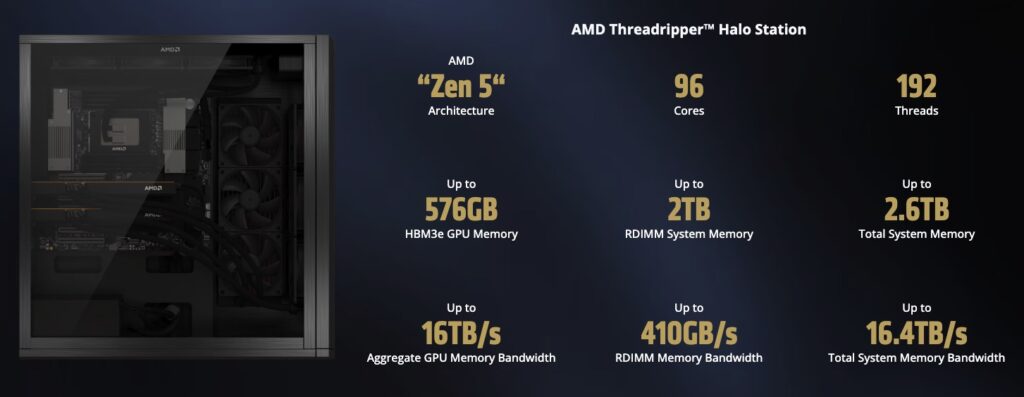
AMD’s reference specification pairs the 96-core, 192-thread Threadripper PRO 9995WX with up to four Instinct MI350P accelerators. At the maximum configuration, those GPUs provide up to 576GB of HBM3e memory, while the workstation can also be equipped with as much as 2TB of DDR5 RDIMM system memory.
That gives the machine up to 2.6TB of combined memory and as much as 16.4TB/s of total system memory bandwidth.
Memory capacity is particularly important for large AI models because the model weights need somewhere to live. Once models become sufficiently large, conventional desktop GPU memory quickly becomes the limiting factor regardless of how powerful the processor itself might be.
Why Run Huge AI Models Locally?
The obvious question is why anyone would put this much computing power beside their desk when enormous AI workloads can already be rented from cloud providers.
There are several reasons.
Local processing gives organisations greater control over sensitive data because information doesn’t necessarily need to leave their own environment. Developers can also run long experiments and agentic workflows without constantly considering cloud inference costs or waiting for shared resources.
AMD is specifically positioning Halo Station for training, fine-tuning and inference, as well as running hundreds of AI agents locally.
The trillion-parameter claim should still be treated as a capability target rather than a guarantee that every model of that size will run quickly. Model architecture, precision, quantisation and context length can dramatically affect memory requirements and performance. But simply having this amount of memory available inside one workstation opens possibilities that conventional PCs cannot realistically approach.
Ryzen AI Halo Is Coming to More Conventional PCs Too
AMD’s IFA announcement isn’t only about an extreme workstation.
Ryzen AI Halo systems are also gaining support for Microsoft’s Project Zenith, a Windows developer environment intended for high-performance AI development devices. These systems can come prepared with tools including Visual Studio Code, Windows Subsystem for Linux, GitHub Copilot CLI and PowerShell.
AMD has also announced a collaboration with SUSE aimed at helping developers move AI applications from local Ryzen AI Halo development systems into enterprise production environments.
Meanwhile, Acer and Lenovo are introducing additional systems powered by Ryzen AI Max 400 Series processors, including the Acer Aspire G AGB110 mini PC and Aspire G 3D 16 notebook, along with Lenovo’s ThinkCentre X Ultra, ThinkCentre M75s Gen 6, ThinkCentre M75q Gen 6 and IdeaPad Slim 3.
The Personal AI PC Is Becoming Something Much Bigger
For the past couple of years, the term “AI PC” has largely meant a laptop with an NPU capable of running relatively lightweight AI features efficiently.
Halo Station shows where the other end of that market is heading.
Instead of using local AI merely for background blur, transcription or image generation, workstation-class systems are beginning to target models and agent workflows that previously belonged in datacenters.
The Threadripper Halo Station is still a prototype and AMD says the platform is coming in 2027, so pricing and final OEM configurations remain unknown. A machine built around multiple Instinct accelerators obviously won’t be aimed at ordinary consumers either.
But the significance is bigger than the workstation itself. If developers can increasingly build, test and operate capable AI systems locally, the future of personal AI may involve far more than simply adding a faster NPU to your next laptop.