
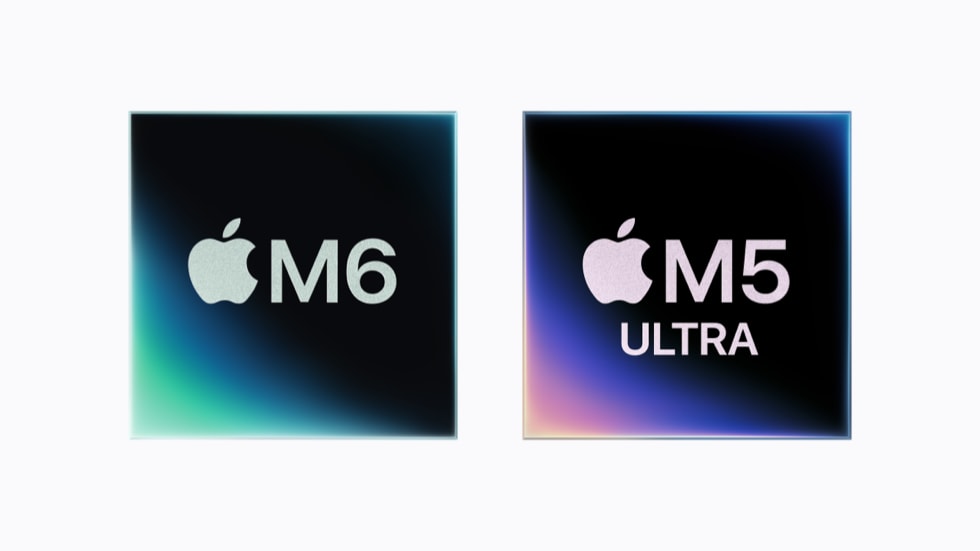
Apple has officially unveiled two new additions to its Apple silicon family, the M6 and M5 Ultra, bringing major improvements in CPU, GPU and AI performance to its latest desktop Macs. The new M6 debuts in the Mac mini, while the significantly more powerful M5 Ultra makes its first appearance in the new Mac Studio.
The M6 represents a particularly important step for Apple silicon as it is the company’s first chip manufactured using a 2nm process. It features a new 12-core CPU, 12-core GPU, Dual 16-core Neural Engine and up to 170GB/s of unified memory bandwidth.
Meanwhile, the M5 Ultra becomes Apple’s most powerful chip to date and introduces the company’s first quad-die M-series architecture. Designed for demanding professional and AI workloads, it scales up to a 36-core CPU, 80-core GPU, 512GB of unified memory and a massive 1.2TB/s of memory bandwidth.
M6 Moves Apple Silicon to 2nm With a New 12-Core CPU

The M6 is built around an entirely new 12-core CPU configuration consisting of two super cores, four performance cores and six efficiency cores, adding two CPU cores over the M5.
Apple claims the new architecture delivers the world’s fastest single-threaded CPU performance, alongside up to 1.2x faster multithreaded performance than M5 and as much as 2.4x the performance of the original M1.
The new super cores are designed to handle demanding single-threaded workloads, while the performance cores can work alongside them during heavier multithreaded tasks. Efficiency cores take care of less intensive background operations to maintain Apple’s focus on performance per watt.
AI is another major part of the M6 architecture. Instead of a single Neural Engine, M6 incorporates a Dual 16-core Neural Engine, which Apple says provides up to twice the peak compute of previous generations. System frameworks can utilise both engines simultaneously to accelerate on-device AI model execution.
Its new 12-core GPU also gains two additional cores over M5 and integrates a Neural Accelerator into every GPU core. Apple claims this results in nearly 30% higher peak GPU compute for AI compared with M5 and more than eight times the performance of M1.
Graphics improvements include an updated shader core architecture, Dynamic Caching and hardware-accelerated ray tracing, alongside a 50% increase in geometry processing rates. M6 supports up to 32GB of unified memory and provides 170GB/s of memory bandwidth, representing a 10% improvement over M5 and 2.5x that of M1.
M5 Ultra Uses Four Dies and Supports Up to 512GB of Unified Memory
While M6 targets a broader range of Mac users, M5 Ultra is built specifically for extremely demanding professional workloads including 3D rendering, visual effects, scientific computing and running large AI models locally.
The biggest architectural change comes from Apple’s next-generation UltraFusion technology. M5 Ultra combines two dual-die M5 Max chips to create Apple’s first quad-die M-series processor.
UltraFusion provides more than 4.4TB/s of inter-die bandwidth with over six times greater connection density, allowing the four dies to behave as a single processor.
At its highest configuration, M5 Ultra offers a 36-core CPU consisting of 12 super cores and 24 performance cores. Apple claims up to 1.25x higher single-threaded and 1.3x higher multithreaded performance compared with M3 Ultra.
The GPU can be configured with as many as 80 cores, with a Neural Accelerator integrated into every core. Apple claims up to 4.5x the peak GPU AI compute of M3 Ultra and more than six times that of M1 Ultra. Graphics performance is meanwhile claimed to be up to 40% faster than M3 Ultra, supported by second-generation Dynamic Caching, hardware-accelerated mesh shading and third-generation ray tracing.
M5 Ultra also features a 32-core Neural Engine and an upgraded Media Engine with dedicated H.264 and HEVC hardware, four ProRes encode and decode engines and hardware-accelerated AV1 decoding, making it particularly suited to high-resolution professional video workflows.
Perhaps its most significant feature for AI developers is memory. M5 Ultra supports up to 512GB of unified memory with an enormous 1.2TB/s of memory bandwidth, 50% higher than M3 Ultra. This allows exceptionally large datasets and AI models with hundreds of billions of parameters to remain entirely in local memory rather than relying on cloud infrastructure.
Apple is also enabling developers to take advantage of the new hardware through Core AI, Core ML, Metal and Xcode. These frameworks can distribute workloads across the CPU, GPU and Neural Engine, allowing developers to run and fine-tune large AI models locally while keeping sensitive data on the Mac.
With M6 bringing Apple silicon into the 2nm era and M5 Ultra introducing a quad-die architecture with up to half a terabyte of unified memory, Apple’s latest chips show that AI compute is becoming just as important as conventional CPU and GPU performance in the company’s next generation of Macs.