
PICO has officially unveiled its next-generation spatial operating system, PICO OS 6, alongside an early preview of its upcoming flagship mixed-reality hardware codenamed Project Swan. The announcement signals a major shift in PICO’s strategy as it moves toward a unified spatial computing ecosystem that blends digital and physical environments.
Unlike incremental updates, PICO OS 6 represents a complete architectural rebuild designed to eliminate friction between different types of applications and environments. The system enables 2D apps, 3D experiences, virtual spaces and real-world views to coexist seamlessly, creating a more natural mixed-reality workflow.
At the core of the new platform is the PICO Spatial Engine, a unified rendering architecture that shifts graphics processing from individual apps to the operating system itself. This approach allows multiple 3D applications and 2D windows to run simultaneously while maintaining responsiveness, enabling virtual elements to blend smoothly with physical surroundings.
Building on this foundation, PICO OS 6 introduces spatial multitasking capabilities. Users can work on complex 3D models with colleagues represented as avatars while keeping web browsers, documents or notes floating within their physical workspace. Input adapts automatically to context, supporting eye tracking and gesture controls, XR controllers for immersive experiences, and traditional keyboard-and-mouse setups for productivity tasks. PICO notes that this architecture is particularly beneficial for enterprise environments, where thousands of institutions rely on its XR platforms for collaboration.
The operating system is also designed as an open ecosystem. PICO OS 6 supports a wide range of application frameworks, including native spatial apps, OpenXR, WebXR, Android applications, web apps and PC VR streaming, treating each as an equal part of the platform rather than prioritising a single ecosystem. This inclusive approach aims to simplify development and broaden software availability.

To support creators, PICO introduced a comprehensive development toolkit. The new Spatial SDK based on Kotlin, a component-driven UI system and plugins for Android Studio allow developers to design and test applications without requiring a headset. A desktop-based emulator further streamlines development workflows. PICO also launched WebSpatial, an open-source framework that enables spatial applications to be built using standard web technologies such as HTML, CSS and React, allowing cross-platform compatibility across PICO OS, VisionOS and Android XR environments.
Game development support has been expanded as well, with deeper integration for Unity and Unreal Engine. Mixed-reality games can now run alongside traditional apps, enabling multitasking scenarios such as gaming while video chatting or browsing content in floating windows.
While PICO OS 6 forms the software backbone, the company also previewed Project Swan, a next-generation XR headset designed to fully realise the platform’s capabilities. The device features new MicroOLED displays with pixel density approaching 4,000 PPI — significantly higher than conventional displays — delivering sharp text and visuals suitable for professional tasks. Average pixel density per degree reaches around 40 PPD, with a central region exceeding 45 PPD for maximum clarity.
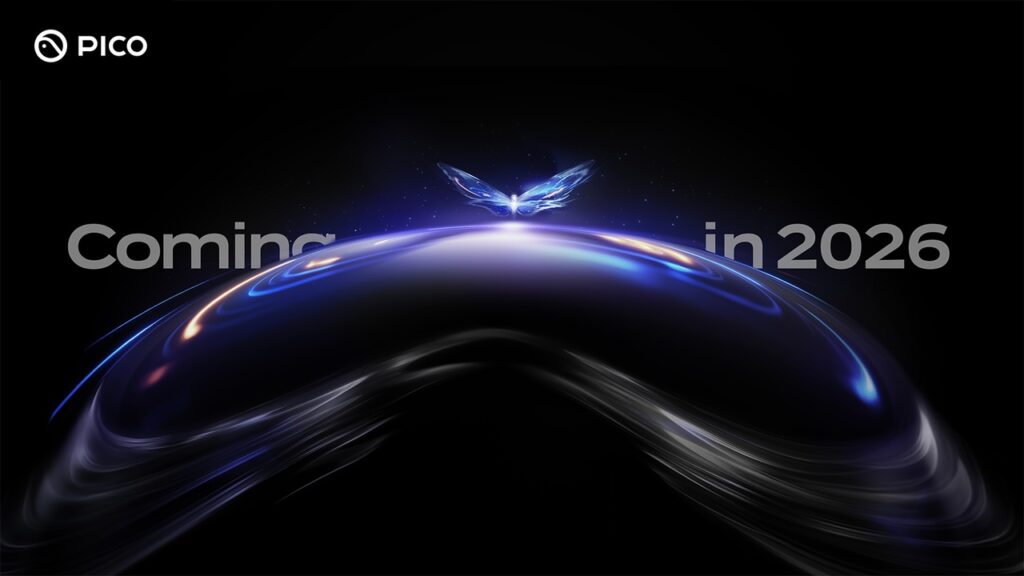
Project Swan also introduces a dual-chip architecture tailored for mixed reality. A dedicated XR processor handles perception and imaging by fusing data from multiple sensors, enabling a detailed representation of the physical world with latency as low as 12 milliseconds. A separate flagship system-on-chip provides more than double the CPU and GPU performance compared to current XR2 Gen 2-based devices, supporting complex applications and high-resolution rendering.
PICO is targeting a global launch for Project Swan in late 2026. Ahead of release, the company has opened a Global Early Access Program to recruit experienced users for closed beta testing of both the hardware and operating system, aiming to refine performance and usability before commercial availability.
With PICO OS 6 and Project Swan, PICO is positioning itself for the next phase of spatial computing, where immersive devices evolve beyond gaming into productivity, collaboration and everyday digital interaction.